

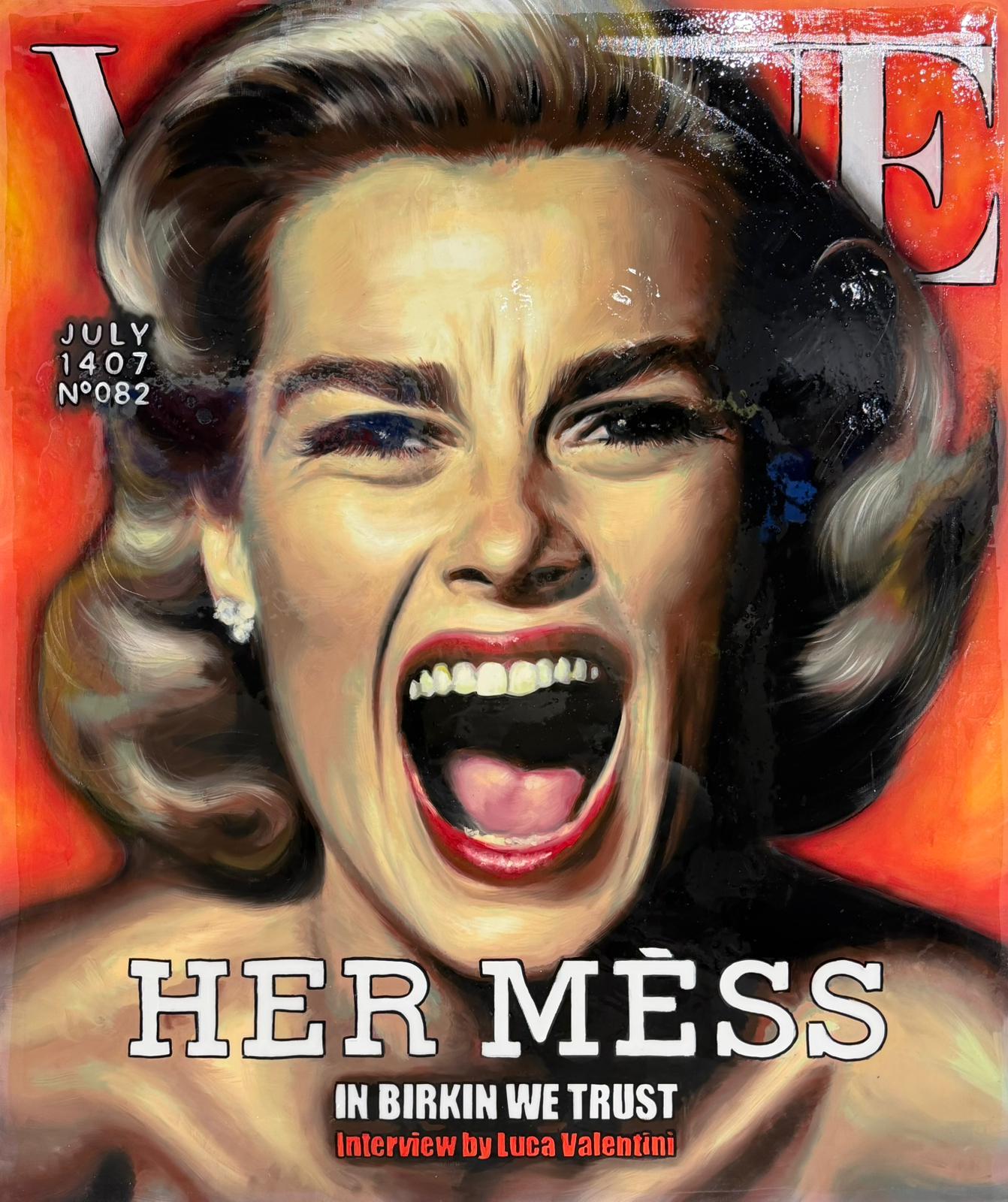
Her Mess
Her Mess
Luca Valentini
Certificate of Authenticity:
Signature: on the back of the canvas
Edition: unique
Year: 2025
SUPPORT: canvas
TECHNIQUE: Mixed technique
DIMENSIONS: x
Couldn't load pickup availability
 Trustpilot: Excellent

 Fast delivery guaranteed within 48 hours
- Free Shipping Worldwide
- Free returns within 14 days

Description by the gallery owner
Description by the gallery owner

Luca Valentini
Luca Valentini's artistic work engages in a lively and provocative dialogue with contemporary popular culture, using images of celebrities as a means to explore the tensions between reality and fiction, the serious and the playful, the iconic and the irreverent. Through the creation of reimagined movie posters, advertisements, and magazine covers, the artist not only pays homage to pop iconography, but transforms it into a subtle tool of both criticism and entertainment. What makes Luca Valentini's work unique is his deliberate use of grimaces and laughter. By depicting famous faces in playful and often exasperated poses, the artist distorts their public image, suggesting a human and vulnerable dimension beneath the veneer of perfection that usually surrounds them. This playful aspect is not a simple visual device, but a reflection on the very nature of fame and media perception: what we see is never entirely serious, but rather a mask, a game of appearances. The texts accompanying the images intensify this contrast, creating a fracture between the expected and the unexpected, between the smile that appears and the meaning that lies beneath. In the virtual world created by the artist, laughter becomes both a sign of lightheartedness and a biting commentary, an invitation to take nothing for granted and to seek the subtext in every visual message. Luca Valentini's playful approach thus aims to destabilize certainties, inviting the viewer to reconsider their relationship with the images and messages constantly presented to us. In this sense, his work emerges as a true space for intellectual experimentation, where irony and provocation become tools for profound reflection on the image-driven society. In conclusion, Luca Valentini's art is a celebration of pop culture, enriched by a vein of irreverence that challenges convention and invites a more critical and informed reading of the media reality that surrounds us.
Other works by the artist
Seguici su:


